No one thing inspired An Exploration of Time. It sprouted from a series of personal reflections about getting older. In its pages, I explore a few questions: What does time feel like? What does it look like?
Time is a uniquely individual experience. No two of us will relate to it in the same way. But I do hope, in some way, you'll see time in a new light.
Aside from being another chance to revisit an old photo, this version of the cover reflects two of the zine's themes: waves and distortion.
Some memories become warped over time. Clarity gets lost the further out they are. It becomes difficult to recall small details, like the time of day or the smell of someone's perfume. Looking back, I don't remember posing for this Christmas photo. I can't help but wonder what I was thinking about.
Waves became a way to express the feeling of moving across time. The crests and falls of having new experiences, quieter periods, and some endings.
Dikenga dia Kongo, or the Kongo Cosmogram, is a religious symbol, worldview, and way of life for the Bântu-Kôngo people. It is formed by combining a cross shape and a circle. The four quadrants correspond to the position of the sun and life's phases. In Kongo cosmology there is the concept of Minika ye minienie: "We feel waves/vibrations and radiations because we ourselves produce all of it." "For the Bantu, a person lives and moves within an ocean of waves/radiations. One is sensitive or immune to them. To be sensitive to waves is...to react negatively or positively to those waves/forces. But to be immune to surrounding waves/forces, is to be less reactive to them or not at all. These differences account for varying degrees in the process of knowing/learning among individuals." - Dr. Fu-Kiau Bunseki, Tying the Spiritual Knot: African Cosmology of the Bântu-Kôngo
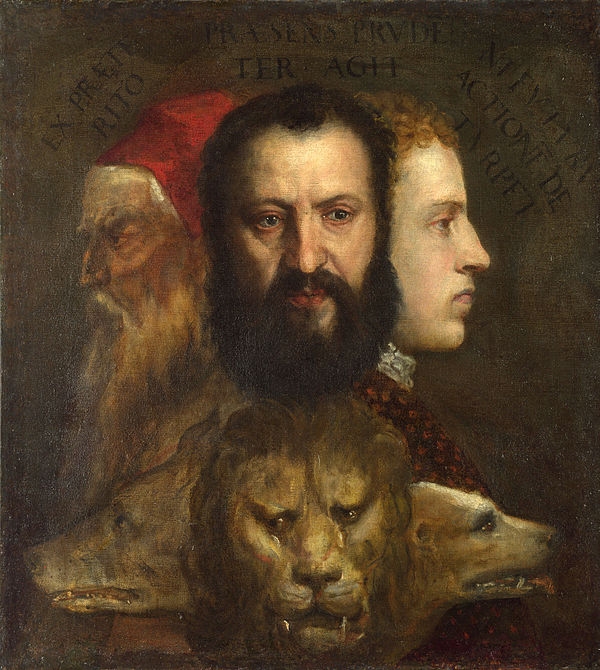
In Titian's The Allegory of Age Governed by Prudence, a Latin inscription is barely visible. It floats above three human heads, each one representing old age, middle age, and youth. Since it was painted in his later years, perhaps Titian wanted it to serve as a warning, or at the very least a reminder. EX PRAETERITO/PRAESENS PRUDENTER AGIT/NE FUTURA ACTIONE DETURPET
"From the experience of the past, the present acts prudently, lest it ruin future action."